Projects

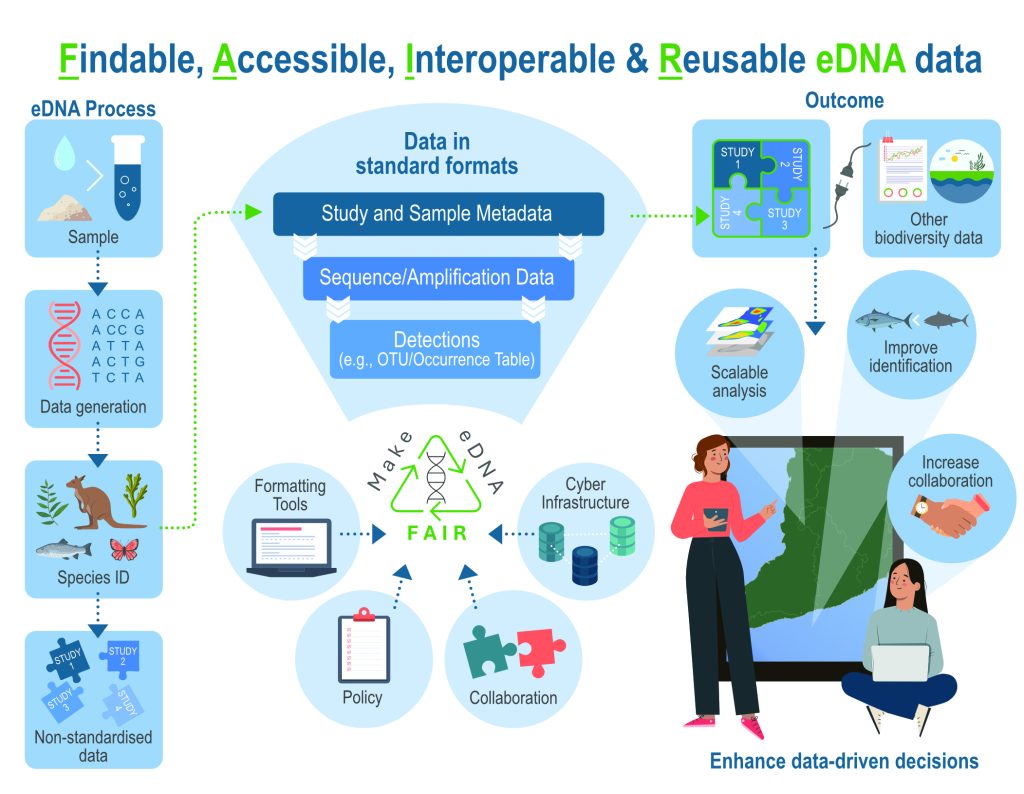
Image: Fig 1 from https://onlinelibrary.wiley.com/doi/10.1002/edn3.70100. Infographic of workflows and outcomes of FAIR eDNA practices.

Making environmental DNA FAIR

[Image: Fig 1 from https://onlinelibrary.wiley.com/doi/10.1002/edn3.70100. Infographic of workflows and outcomes of FAIR eDNA practices.] Environmental DNA (eDNA) is a cutting-edge scientific technique that involves collecting and analysing genetic material shed by organisms into their surrounding environment such as water and soil. While millions of DNA sequences are typically generated and assigned to taxa in each […]

Making environmental DNA FAIR Read More »

Pacific Islands Marine Bioinvasion Alert Network (PacMAN)

The PacMAN project will increase the technical and scientific capacity in marine invasive species early warning and early detection using the latest technologies in genomics and metabarcoding (eDNA). It will also directly support the implementation of national and international policies with the aim to reduce and prevent the introduction of new invasive species into the

Pacific Islands Marine Bioinvasion Alert Network (PacMAN) Read More »

OceanOmics: Monitoring & Protecting Ocean Life

[Image: Abrolhos Islands | Credit: Giacomo d’Orlando & Minderoo] Genomics, automation and artificial intelligence (AI) are technologies that have the potential to transform ocean conservation. Minderoo Foundation’s OceanOmics program is advancing these technologies to improve knowledge gained through marine monitoring, to inform how we combat threats to ocean health. Our goal is to use eDNA

OceanOmics: Monitoring & Protecting Ocean Life Read More »

National Biodiversity DNA Library (NBDL)

Australia’s National Biodiversity DNA Library (NBDL) will use cutting edge technology to create DNA reference sequences for Australia’s species from expertly identified specimens held in Australian natural history collections, and make these freely available via an online portal. The first priority area for this initiative is to generate whole mitochondrial genomes for all named species

National Biodiversity DNA Library (NBDL) Read More »

DNA-based approaches for fisheries monitoring

[Top Image: Port of Bandim in the early morning, with arrival of local fishermen (Bissau, Guine-Bissau)] This initiative aims to establish an Atlantic network for marine fish monitoring using DNA-based approaches. Once fully established, this network will provide broad-scale data to support scientific advise on sustainable management and conservation of fisheries resources and fish biodiversity

DNA-based approaches for fisheries monitoring Read More »

Scripps Ecological Observatory (SEO)

The Scripps Ecological Observatory (SEO) establishes a modern observational program, building on over a century of environmental observations at the Scripps Pier. SEO will consolidate and improve ongoing measurements, while applying new and emerging technologies to understand ecological change at an unprecedented level of detail. These technologies include; SEO’s goal is to develop a sustained

Scripps Ecological Observatory (SEO) Read More »

Pacific eDNA Coastal Observatory (PECO)

Pacific eDNA Coastal Observatory (PECO) will develop efficient tools, platforms and networks to enable the use of environmental DNA for broad-scale biogeographic assessment, build capacity to track biodiversity changes in time, and connect users with updatable predictive tools on biodiversity changes throughout the Ocean Decade.  PECO is a growing network that spans a latitudinal cross-section

Pacific eDNA Coastal Observatory (PECO) Read More »

Scroll to Top